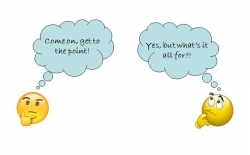
People have differing needs for detail in their lives and they think in different ways. This means we need to vary the way we talk and write to them if we are to communicate effectively with them. Everyone can be placed somewhere on a scale between the 'Small Picture' person, who needs lots and lots of specific detail and the 'Big Picture' person who thinks in global terms and large chunks of general information.
'Small Picture' people like to work with all the small details. They don't want the big picture first because they need to have the specifics, often down to the smallest detail, before they can start to understand what is needed. Try giving them an overview first and they'll just switch off, waiting for you to get to the point. By contrast, 'Big Picture' people frequently haven't got time for details - after all, details aren't important when you're thinking and working with a broad brush. 'Big Picture' people often think in concepts and abstracts. They'd rather you gave them the overall framework or brief of what's happening than get bogged down by you going into details.
You can discover whether someone favours 'Big Picture' thinking or is happier with the 'Small Picture' just by asking them some questions and analysing their responses.
'Small Picture' people will give you all the details and go to great lengths to explain everything when you ask a question while 'Big Picture' people will give you an overview without details and tend to use large generalizations.
Not surprisingly, 'Small Picture' people can become frustrated and switch off when 'Big Picture' people are explaining things because there is little or no detail in what they say. Likewise, 'Big Picture' people often become frustrated and stop listening when 'Small Picture' people are talking because they go into much too much detail.
So, how can you apply this to the real world?
In negotiations with 'Small Picture' people, avoid generalizations and vagueness. Break things down into the detail and be specific and present ideas and actions in logical sequences.
In negotiations with 'Big Picture' people, avoid details and present them with the bigger picture.
When managing a 'Small Picture' person, tell them in detail what needs to be done and ensure that there is a logical sequence. Don't expect them to think about the bigger picture.
When managing a 'Big Picture' person, skip the details and give them a broad overview. Tell them what the end result needs to be and let them fill in the rest.
Some examples of 'Influencing Language' you can use with 'Small Picture' people are words such as: Next, Then, Precisely, Exactly, Specifically, First, Second, Details etc and for 'Big Picture' people it's words such as: Generally, In brief, Big picture, Framework, Result, Overview etc.